

TL;DR
- Choosing a payments model is an important strategic decision, but it isn’t what determines long-term success.
- The strongest embedded payments programs are built through merchant adoption, operational excellence, and continuous improvement.
- SaaS companies create competitive advantage by building organizational capabilities, not simply selecting the right operating model.
- As businesses evolve, their payments strategy should evolve alongside them.
- The most valuable question isn’t “Should we become a Payment Facilitator?” It’s “What should we build next?”
For SaaS companies exploring embedded payment platforms, one question tends to dominate the conversation: Should we become a Payment Facilitator?
It’s an understandable place to start. Payment Facilitation has become one of the most discussed topics in embedded payments because it offers greater control, greater flexibility, and the potential for stronger economics. As platforms mature, many naturally begin evaluating whether it’s the right next step for their business.
The problem isn’t the question itself. It’s treating it as the most important decision you’ll make.
After working with SaaS companies across a wide range of industries, we’ve found that the organizations creating the greatest long-term value rarely spend much time looking back at the operating model they selected. Instead, they’re focused on what comes next. Their attention shifts from choosing how payments operate to improving how payments support customers, strengthen the business, and create new opportunities for growth.
Choosing a payments model determines how payments are structured. Building a successful payments business requires something entirely different. It depends on how effectively the organization drives merchant adoption, integrates payments into the customer experience, aligns internal teams, and continues improving long after implementation is complete.
Two SaaS companies can choose the exact same operating model and produce dramatically different outcomes. One steadily increases merchant adoption, simplifies onboarding, improves operational efficiency, and turns payments into a meaningful contributor to customer retention. The other struggles to activate merchants, experiences inconsistent adoption, and wonders why payments never became the growth engine leadership expected.
The difference usually isn’t the operating model. It’s everything the organization built around it.
Why SaaS Companies Start with the Wrong Question
It’s easy to understand why operating models receive so much attention.
They influence implementation timelines, compliance responsibilities, revenue opportunities, and operational ownership. Referral models, hybrid approaches, and Payment Facilitation each involve different tradeoffs, and selecting the right approach is an important part of building a successful embedded payments strategy.
The challenge is that operating models are also one of the few embedded payments decisions that have a clear beginning and end. Leadership evaluates the available options, selects the model that best aligns with the business, and moves into implementation.
Implementation is a milestone, not a finish line. Once embedded payments go live, the focus shifts toward merchant activation, customer onboarding, operational efficiency, reporting, support, and continuous product improvement. Those capabilities determine whether payments become a strategic advantage or simply another feature within the software platform.
Imagine two field service SaaS companies serving similar customers and processing roughly the same annual payment volume. Both operate under the same embedded payments model, offer comparable functionality, and compete in the same market.
One organization introduces integrated payments during every sales conversation, reinforces its value throughout onboarding, and continuously refines the customer experience based on merchant feedback. Leadership tracks merchant adoption alongside other core business metrics because they understand adoption is a leading indicator of long-term growth.
The second organization successfully launched embedded payments several years ago but largely considers the project complete. Sales discuss payments only when customers ask. Merchant activation varies depending on the onboarding specialist, and reporting focuses almost exclusively on processing volume. Leadership sees payments as an operational function rather than a strategic capability.
Both companies selected the same operating model. Only one built a better payments business.
→ Related: Why Most Embedded Payments Programs Plateau After Launch
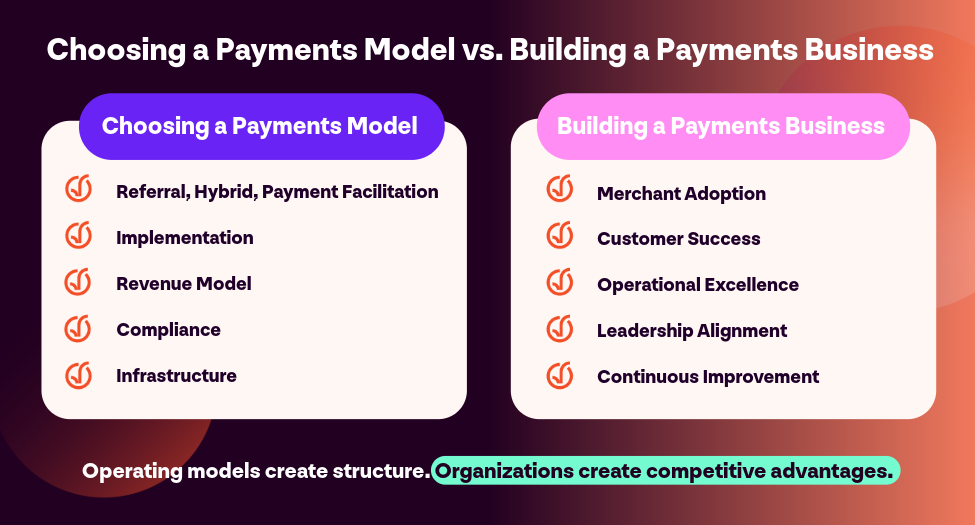
Choosing a Payments Model Doesn’t Build a Payments Business
Selecting an operating model is an important milestone, but it’s only the beginning of the journey. Once the implementation is complete, every SaaS company faces the same challenge: transforming embedded payments from a feature customers can use into a capability they want to use.
Merchant adoption doesn’t increase because an organization selected the “right” payments model. It increases because Sales consistently communicates the value of integrated payments, Customer Success reinforces that value during onboarding, Product reduces friction throughout the payment experience, and leadership continues measuring progress long after implementation. Those capabilities require consistent investment across the business.
This is one of the reasons embedded payments systems often produce very different results, even among SaaS companies operating in the same vertical. They may share similar technology, comparable products, and even the same payments infrastructure. The organizations that outperform have usually invested more heavily in the people, processes, and accountability required to help payments become part of the customer experience rather than simply another feature within it.
Infrastructure Is Only the Beginning
Think about any successful SaaS business. Launching a CRM doesn’t create a great sales organization, purchasing a marketing automation platform doesn’t automatically improve demand generation, and implementing a customer success platform doesn’t guarantee higher retention.
Technology enables better outcomes. Organizations create them. Embedded payments follow the same pattern.
The payments platform provides the infrastructure to accept transactions, manage merchants, and support integrated workflows. The business determines how effectively those capabilities are introduced, adopted, measured, and improved over time. That distinction is easy to overlook because infrastructure is visible. Organizational capability is built gradually, often through hundreds of small improvements that compound over months and years.
Over time, those improvements have become difficult for competitors to replicate. Another software company can launch embedded payments, match your pricing, or even adopt the same operating model. Replicating years of operational refinement, customer insight, and cross-functional alignment is much more challenging.
Building Capability Is a Cross-Functional Effort
One of the biggest misconceptions about embedded payments is that it’s primarily owned by one department.
Sometimes Product owns it because they’re responsible for the integration. Sometimes Operations owns it because they’re responsible for onboarding merchants. In other organizations, Finance or Payments owns the relationship because they oversee revenue and compliance.
The most successful embedded payments programs don’t belong to a single department. They become part of how the entire business operates.
Sales introduces the value of integrated payments early in the customer journey instead of waiting until implementation. Customer Success reinforces that value during onboarding and helps merchants adopt the capabilities they’ve purchased. Product continuously removes friction from the payment experience, while Operations ensures merchants can be supported consistently as the business grows.
Organizations that consistently outperform don’t measure payments exclusively by processing volume or revenue. They look at merchant activation, adoption trends, onboarding completion, support metrics, customer retention, and operational efficiency because those indicators reveal whether the payments business is becoming stronger over time.
That’s one of the reasons mature embedded payments programs become increasingly difficult to replicate.
The Companies That Continue Improving Create the Greatest Advantage
One pattern we’ve consistently observed is that successful SaaS companies never consider embedded payments “finished”.
As customer expectations change, they refine onboarding experiences. As transaction volume grows, they improve reporting and operational workflows. As enterprise customers introduce new requirements, Product and Customer Success adapt the payment experience to support those needs. Every improvement makes payments more valuable to customers while strengthening the business behind it.
This continuous improvement is also what makes embedded payments increasingly strategic over time. Leadership stops viewing payments as an implementation project and begins evaluating how it contributes to customer retention, product differentiation, operational efficiency, and long-term enterprise value.
That evolution doesn’t require a different operating model. It requires a different mindset.
Organizations that view embedded payments as a business capability continue investing long after launch. Organizations that view it primarily as a technology implementation often discover that growth begins to plateau once the excitement of launch has faded.
That doesn’t mean the technology failed. It usually means the organization stopped building.
Great Payments Strategies Continue to Evolve
One of the unintended consequences of focusing too heavily on operating models is that they can begin to feel permanent. Leadership spends months evaluating referral models, hybrid approaches, or Payment Facilitation, makes a decision, and then moves on to other priorities. The assumption is that the strategy has been set and they no longer need to focus on payments.
In reality, the business rarely stands still. Customer expectations change. New products are introduced. Enterprise clients bring different requirements than early adopters. Merchant volumes increase, operational processes become more sophisticated, and leadership begins looking at payments through a much broader strategic lens. The priorities of a SaaS company with 100 merchants are very different from those of a company with 5,000 merchants, even if they’re serving the same market.
That raises an important question. Should the payments strategy remain exactly the same while everything else about the business evolves? For many organizations, the answer is no.
A company focused on launching embedded payments may prioritize speed to market and a streamlined implementation experience. Several years later, that same organization may be more concerned with improving merchant adoption, strengthening operational controls, or creating a more differentiated customer experience. Eventually, leadership may begin evaluating how payments contribute to enterprise value, customer retention, or broader workflow ownership.
Those aren’t signs that the original strategy was wrong. They’re signs that the business has matured.
This is the idea behind our Flex Framework. Rather than viewing embedded payments as a single decision, our framework encourages SaaS companies to evaluate whether their current approach still aligns with where the business is today and where it’s headed next.
The objective isn’t to become a Payment Facilitator simply because other successful SaaS companies have. The objective is to make deliberate decisions that support the next stage of growth. For one organization, that may mean improving merchant adoption before taking on additional operational complexity. For another, it may mean increasing control over the customer experience or creating new revenue opportunities through a different operating model.
The common thread isn’t the model itself. It’s the discipline of continually evaluating whether your payments strategy still serves the business as it evolves.
The goal isn’t to choose the most complex payments strategy. It’s to choose the strategy that best supports where your business is today while preserving the flexibility to evolve tomorrow.
One of the most common questions software companies ask is, “When should we become a Payment Facilitator?” It’s a reasonable question, but it’s difficult to answer without understanding the broader context of the business.
A better conversation begins with questions like these:
- Are we consistently activating merchants after implementation?
- Have we built operational processes that can scale with the business?
- Do we understand the customer experience well enough to take on greater ownership?
- Are we solving the right problems for where the business is today?
These questions help leadership determine whether changing operating models is the right next step or whether greater value can be created by strengthening the capabilities that already exist.
The Cost of Standing Still
One of the easiest mistakes to make is assuming that a successful implementation means the difficult work is complete. In reality, the opposite is often true.
Implementation creates the opportunity to build a successful payments business. Whether that opportunity is realized depends on what happens over the next several years.
Organizations that continue investing in merchant adoption, operational improvements, and customer experience often discover new opportunities for growth they couldn’t see immediately after launch. Organizations that assume payments will continue growing on its own frequently experience a different outcome. Merchant adoption levels off. Operational processes become increasingly manual. Product innovation shifts toward other priorities, and payments gradually become another feature rather than a strategic advantage.
Rarely does this happen because the technology wasn’t capable. More often, it happens because the organization stopped evolving while the market continued moving forward.
That’s why embedded payments shouldn’t be viewed as a project with a completion date. It’s an operating capability that should mature alongside the business.
Ask Better Questions
Embedded payments have evolved significantly over the past decade. Early conversations centered on implementation. Could SaaS companies successfully integrate payments into their platforms? As embedded payments became more common, attention shifted toward operating models. Referral programs, hybrid approaches, and Payment Facilitation became the focus as companies looked for the best way to structure their payments business.
Those conversations remain important, but they no longer tell the whole story.
As embedded payments become a standard part of vertical SaaS, the companies creating the greatest value are asking different questions. They’re spending less time searching for the perfect operating model and more time evaluating how payments support the broader business.
Their priorities begin to evolve as well.
| Traditional Focus | Strategic Focus |
|---|---|
| Implementation milestones | Merchant adoption |
| Processing volume | Customer retention and operational impact |
| Whether payments are working | How payments can create more value |
| Launch completion | Continuous improvement |
| Payment acceptance | A stronger product and customer experience |
Organizations that make this transition begin evaluating payments as a strategic business capability rather than a completed implementation project. Those are fundamentally different conversations, and they often produce fundamentally different outcomes.
That doesn’t happen because of a referral model, a hybrid approach, or Payment Facilitation. It happens because leadership never stops building.
The companies creating the greatest value don’t stop after choosing a payments model. They continue building the business behind it.
Conclusion
Every embedded payments strategy begins with an operating model. The strongest ones don’t end there. They continue evolving as the business grows, customer expectations change, and new opportunities emerge to create value through payments.
Foundations, however, aren’t what create lasting competitive advantage. That advantage is built over time through consistent execution, stronger merchant adoption, better operational processes, closer alignment across Sales, Product, Customer Success, and Leadership, and a willingness to continually improve as the business evolves.
The goal isn’t to choose the most sophisticated payments strategy. It’s to choose the strategy that creates the most value for your business today while preserving the flexibility to adapt as your business evolves.
When leadership shifts its focus from selecting the “right” payments model to strengthening the business behind payments, the conversation changes. Payments become more than infrastructure. It becomes a capability that improves customer experience, supports long-term growth, and creates lasting enterprise value.
Frequently Asked Questions
Q. Isn’t choosing the right payments model still important?
A. Absolutely. The operating model influences implementation, economics, compliance, customer experience, and operational ownership. The point isn’t that operating models are unimportant. It’s that they’re only one part of building a successful embedded payments business. Long-term success depends on how effectively the organization drives adoption, supports merchants, and continuously improves the customer experience.
Q. When should a software company consider becoming a Payment Facilitator?
A. There isn’t a universal answer because every software company is at a different stage of growth. Rather than viewing Payment Facilitation as the default next step, evaluate whether it supports your current business priorities. For some organizations, improving merchant adoption or operational processes may create greater value than changing operating models.
Q. How do successful SaaS companies evaluate their payments strategy?
A. The strongest organizations revisit their payments strategy as the business evolves. As customer expectations, operational priorities, and growth objectives change, they evaluate whether their current approach still aligns with where the business is today and where it’s headed next.
Q. What separates mature embedded payments programs from average ones?
A. The most successful programs treat embedded payments as an evolving business capability rather than a completed implementation project. They continuously improve merchant onboarding, customer adoption, operational efficiency, reporting, and the overall payment experience instead of assuming implementation alone will drive long-term growth. Over time, these capabilities become increasingly important to customers and can strengthen how investors and prospective acquirers evaluate the business.

by Xplor Pay
-
First published: July 16 2026
Written by: Xplor Pay