

TL;DR Executive Summary
- Every successful SaaS platform evolves over time. Your payments strategy should evolve with it.
- Choosing a referral, hybrid, or PFaaS model is only the beginning. Long-term success comes from continuously optimizing your payments strategy as your business grows.
- Static payments models often create hidden constraints that reduce adoption, revenue per customer, and long-term profitability.
- Leading software companies optimize payments differently across customer segments instead of applying a one-size-fits-all approach.
- The Flex Framework was designed to help SaaS platforms launch quickly, increase adoption, optimize economics, and evolve their payments strategy over time.
The Core Misconception
Every successful SaaS platform evolves. Products become more sophisticated. Customers become more demanding. Sales strategies mature. Pricing changes. Markets expand.
Yet many embedded payments programs remain almost exactly as they were when they launched. That’s where growth begins to stall.
Most vertical SaaS platforms approach embedded payments with a simple question: Should we choose referral, hybrid, or Payment Facilitation? It seems like a reasonable decision point, but it leads teams into a fixed mindset too early.
The real issue isn’t choosing the wrong model. It’s assuming the first model you choose will continue supporting the business as it grows.
In practice, many companies optimize too early for revenue share before they’ve built the operational maturity needed to drive adoption at scale. That often leads to slower launches, lower attach rates, and underwhelming long-term revenue performance.
The highest-performing platforms take a different approach. They don’t treat payments as a one-time implementation decision. They treat it as a strategic capability that should evolve alongside the business, creating new opportunities to increase adoption, improve economics, and support long-term growth.
Through our work helping build and scale more than 20 vertical SaaS platforms, we’ve seen this pattern repeatedly. It’s one of the reasons we developed the Flex Framework: to give SaaS companies the flexibility to launch with the payments model that makes sense today while preserving the ability to evolve as their platform, customers, and business goals change.
→ Related: Flex Framework
Why a Fixed Model Creates a Ceiling
A static payments model doesn’t just define how transactions are processed. It defines how much revenue a platform can ultimately capture.
At first, the impact is hard to see. Sales teams continue to operate, pricing remains stable, and revenue looks predictable. But underneath that stability, the system is quietly limiting growth.
When the same model is applied across all customer segments, it reduces flexibility in how deals are structured. Pricing becomes less aligned with customer value. Adoption slows because the approach doesn’t fit every use case. Over time, revenue per customer begins to begins to plateau.
Even platforms processing significant volume, say $10 million annually, can still be leaving significant revenue on the table simply because their payments strategy doesn’t adapt to different customer segments, sales motions, or business objectives.
This is one of the hidden costs of static payments models. They often don’t fail dramatically. Instead, they quietly become less effective as the business evolves around them.
The challenge is that this doesn’t show up as a clear failure. It shows up as a ceiling that becomes visible only when growth starts to slow.
The Real Lever: Evolving Your Payments Strategy Over Time
The strongest SaaS companies don’t think of payments as a single decision. They think of it as a strategy that evolves with the platform.
Instead of trying to optimize everything at once, they progress through distinct stages of growth.
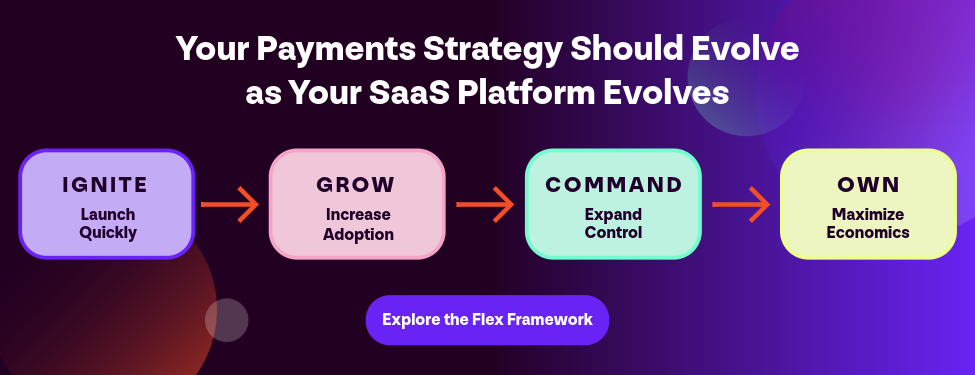
- Early on, speed matters most. The priority is launching embedded payments, reducing implementation friction, and generating initial revenue.
- As the platform grows, adoption becomes the focus. Success depends on increasing attach rates, improving activation, and making payments a natural part of the customer experience.
- Over time, the emphasis shifts again. Mature platforms look for ways to optimize revenue per customer, improve margins, gain greater operational control, and support increasingly complex customer relationships.
Each phase builds on the last. Instead of trying to optimize everything at once, these companies allow their payments strategy to mature alongside their business.
This philosophy is the foundation of the Flex Framework. Instead of asking software companies to choose a single path, it provides the flexibility to launch quickly, increase adoption, expand operational capabilities, and maximize long-term economics as the business evolves.
This progression is what turns payments from incremental revenue into a strategic growth engine.
How Leading SaaS Platforms Approach Payments Strategy
High-performing SaaS platforms treat payments as a dynamic part of their growth strategy, not a fixed infrastructure decision.
Instead of applying one model across the entire business, they focus on three principles: optimizing by customer segment, evolving their strategy over time, and aligning payments with how the business grows.
Optimize by Customer Segment
Not all customers generate the same value, and they shouldn’t be treated the same way in payments strategy.
- SMBs often prioritize speed, simplicity, and ease of onboarding, making adoption the primary focus.
- Mid-market customers typically require a balance between ease of implementation, operational flexibility, and revenue opportunity.
- Enterprise organizations may justify a different approach entirely, one that emphasizes long-term economics, operational control, and strategic partnership.
This approach isn’t about complexity. It’s to align the payments strategy with the value and needs of each customer segment.
That allows platforms to increase adoption where simplicity matters most while maximizing long-term revenue opportunities where greater flexibility creates value.
Evolve Intentionally
Payments strategy should grow with the business, not remain fixed after launch.
Early-stage companies naturally focus on speed to market and generating initial revenue. As the platform grows, attention shifts toward increasing attach rates, improving consistency in how payments are positioned, and making adoption part of the customer experience. Over time, mature organizations begin optimizing economics, expanding operational capabilities, and refining how payments support broader business objectives.
The important shift is that these changes happen intentionally rather than reactively.
The strongest SaaS companies don’t wait until growth slows to rethink payments. They continuously evaluate whether their strategy still supports where the business is headed. As platforms scale, that often means addressing new operational challenges around merchant onboarding, adoption, support, reporting, and program management that weren’t priorities during the initial launch.
→ Related: The Operational Challenges SaaS Platforms Face as Embedded Payments Scale
Align Payments With Growth Strategy
Many organizations still treat payments as a financial function. Leading SaaS platforms treat it as a growth function.
Payments influences how sales teams position value, how pricing is structured, how customers are onboarded, and ultimately how much revenue the platform captures over time. When payments is aligned with these growth levers, it supports adoption, expansion, and retention. When it isn’t, it quietly introduces friction into each of these areas.
The difference isn’t technology. It’s whether payments is viewed as infrastructure or as a strategic business capability.
Revenue Implications
The business impact of this approach becomes clear when you look at revenue performance. Consider two SaaS platforms, each processing $10 million in annual payment volume. They serve similar customers, offer comparable products, and process the same amount of payment volume.
Yet one generates substantially more payments revenue than the other. The difference isn’t transaction volume. It’s the strategy behind payments.
The revenue a platform captures depends largely on how its payments strategy is structured.
| Program Type | Revenue Capture Example | Insight |
| Referral | $650,000 (65% of potential margin) | Fast adoption, low operational overhead, but limits long-term margin |
| Hybrid | $750,000 (75% of potential margin) | Balanced approach: some control and margin, scalable without major complexity |
| Payment Facilitation | $950,000 (95% of potential margin) | High margin and control, maximizes revenue from strategic accounts, but operationally intensive |
Key Insight: The most successful SaaS companies don’t maximize payments revenue by choosing the “best” program. They maximize revenue by using the right program at the right stage of growth and for the right customer segment.
Two platforms with identical payment volume and customer bases can generate dramatically different payments revenue based on how they structure their program.
These figures are illustrative, but they reinforce an important point: payment volume alone doesn’t determine payment revenue. Strategy does.
This is why static payments models create hidden constraints over time.
Platforms that tailor their approach by customer segment, evolve their payments strategy as the business grows, and continuously optimize adoption and economics can unlock significantly more revenue without changing their core software platform.
Flexibility isn’t simply about offering multiple program types. It’s about creating the ability to maximize long-term enterprise value as the business evolves.
Strategic Principles for Payments Success
The SaaS platforms that consistently outperform rarely treat payments as a standalone initiative. Instead, they follow a set of operating principles that allow their payments strategy to evolve alongside the business.
- They segment intentionally, recognizing that different customer types justify different approaches.
- They prioritize adoption before optimization, understanding that payments revenue only grows when merchants actively use the solution.
- They improve economics over time rather than introducing unnecessary operational complexity too early.
- They align payments with their go-to-market strategy, ensuring sales, pricing, onboarding, and customer success all reinforce the same objectives.
Most importantly, they build flexibility into the operating model so their payments strategy can evolve without disrupting the business.
Together, these principles create something much more valuable than a successful payments program. They create a payments strategy that continues generating value as the business grows.
Are You Leaving Revenue on the Table?
One of the biggest challenges with embedded payments is that underperformance is rarely obvious. Programs don’t usually fail overnight. Instead, they gradually become less aligned with the business they were designed to support.
As products evolve, customer expectations change, and go-to-market strategies mature, payments strategies can quietly fall behind.
A few simple questions can help reveal whether that’s happening:
- Are you using the same payments approach across every customer segment?
- Have you intentionally revisited your payments strategy within the last 12–24 months?
- Does your current payments approach support how your sales team actually sells today?
- Can you adapt your payments strategy without slowing execution or disrupting existing merchants?
If you answered “no” to any of these questions, your payments strategy may no longer be aligned with where your business is today. That doesn’t necessarily mean you’ve chosen the wrong model. It may simply mean your business has evolved beyond it.
Learn how the Flex Framework helps SaaS platforms evolve their payments strategy over time.
Key Signs Your Payments Strategy Needs Attention
Some warning signs are easier to recognize than others.
If any of the following sound familiar, it may be time to reevaluate your payments strategy:
- The same payments approach is applied across every customer segment.
- Merchant adoption has slowed or plateaued.
- Payments create friction during the sales process.
- Pricing or deal structures have become difficult to adapt.
- High-value customers aren’t reaching their full revenue potential.
- Payments performance has remained largely unchanged despite business growth.
None of these signals necessarily indicate a failed payments program.
Together, however, they often suggest that the strategy supporting their payments program has stopped evolving alongside the business.
Reframing the Embedded Payments Category
The embedded payments conversation has traditionally centered on one question: Which payments model should we choose? While that has been the industry focus for years, it’s becoming the wrong question.
The future isn’t about selecting the right referral, hybrid, or PFaaS model once. It’s about building a payments strategy that can adapt as your business grows. Leading SaaS platforms don’t optimize around a single model. They build flexible operating models that support different customer segments, evolve with changing business priorities, and align payments with broader growth objectives.
Platforms that adopt this mindset don’t just generate more payments revenue. They build more scalable, resilient software businesses that are better positioned for long-term growth. Embedded payments stop being infrastructure and become a strategic business capability that supports adoption, customer retention, and enterprise value.
→ Related: Embedded Payments Is Becoming a Diligence Topic
Frequently Asked Questions
Q. How can we increase payments revenue without adding complexity?
A. Start with adoption. The more customers actively using your payments solution, the more opportunity you have to generate revenue over time. From there, focus on evolving your payments strategy as your platform grows, improving revenue per customer, operational efficiency, and long-term economics. The goal isn’t to optimize everything on day one. It’s to build a strategy that improves as your business matures.
Q. Should we standardize on one payments model across the business?
A. In most cases, no. A single payments model often limits flexibility and leaves revenue opportunities untapped. Different customer segments have different needs, and your payments strategy should reflect those differences. The strongest SaaS platforms align payments with customer value, business objectives, and long-term growth rather than assuming one approach is right for every merchant.
Q. How do we know if our payments strategy is underperforming?
A. Look for stagnation in key areas like adoption, revenue per customer, and margin. If those metrics haven’t improved over time, or if your approach hasn’t evolved in the last 12–24 months, it’s a strong signal your strategy is too rigid. Underperformance in payments is often subtle, but it shows up in missed revenue over time.
Q. What is the Flex Framework?
A. The Flex Framework is Xplor Pay’s approach to embedded payments that gives SaaS platforms the flexibility to launch, grow, and optimize their payments strategy over time. Instead of forcing companies into a single operating model, it provides multiple paths to increase adoption, improve economics, and evolve alongside the business as priorities change.
Closing Thoughts
Across the vertical SaaS industry, and through our work building and scaling more than 20 platforms over the last two decades, we’ve seen one pattern emerge again and again: the most successful companies don’t build static payments programs. They build payments strategies that evolve alongside their business.
Every SaaS platform expects its products, pricing, customer base, and go-to-market strategy to change over time. Embedded payments should be no different. The competitive advantage doesn’t come from choosing the perfect referral, hybrid, or PFaaS model on day one. It comes from continuously adapting your payments strategy to support where your business is headed next.
That’s the philosophy behind the Flex Framework. It was built to give SaaS platforms the flexibility to launch quickly, increase adoption, optimize economics, and continue evolving their payments strategy without rebuilding it from scratch.
As embedded payments become a more strategic part of every software platform, the companies that create the most long-term value won’t be the ones that chose the “right” model. They’ll be the ones that built a payments strategy capable of growing with the business.

by Xplor Pay
Contributor: Xplor Pay
-
First published: April 14 2026
Written by: Xplor Pay