

TL;DR
- Least Cost Routing (LCR) gives eligible debit transactions additional routing options rather than relying on a single default network path.
- Debit routing can affect processing costs because different networks and transaction characteristics can have different economics.
- The lowest-cost route isn’t necessarily the same for every transaction. LCR uses a configured routing strategy to select among eligible routing options.
- The potential value of LCR depends on the payments portfolio, including eligible debit volume, transaction mix, ticket size, merchant category code, available networks, and current routing economics.
- LCR is one component of a broader payments optimization strategy. As payments programs mature, software platforms can look beyond adoption and volume to strategies that improve processing economics, including opportunities to reduce interchange expense.
Least Cost Routing Explained
Least Cost Routing (LCR) is a payments optimization approach that routes eligible debit transactions across available debit networks based on a configured routing strategy, with the goal of improving processing economics.
For certain debit transactions, more than one network may be available to process the payment. LCR creates the flexibility to consider the economics of those available routes when determining how an eligible transaction should be processed. For software platforms processing significant payments volume, that flexibility can create another opportunity to improve the economics of the payments program they’re already operating. Depending on the payments provider and existing integration, LCR may also be enabled without requiring additional development by the SaaS platform.
To understand where LCR fits, it helps to distinguish it from two related concepts: debit routing and alternative debit routing.
| Term | What It Means |
|---|---|
| Debit routing | The routing of debit card transactions to a debit network for processing. |
| Alternative debit routing | The process of routing eligible card transactions to a supported and available debit network (single message format) as opposed to major credit network rails (dual message format). |
| Least Cost Routing (LCR) | An optimization approach for alternative debit routing that considers processing economics and interchange expense when selecting among available debit networks of eligible debit cards. |
The important distinction is that LCR isn’t simply about finding one network that’s always cheaper. Available routing options and their economics can vary from card to card and transaction to transaction.
For SaaS platforms that have already built an embedded payments program, understanding those transaction-level economics becomes more relevant as payments volume grows and card networks continue to enhance and evolve interchange, interchange programs, and assessment costs.
How Least Cost Routing Works
When an eligible debit transaction occurs, there may be more than one network capable of processing it. LCR evaluates the eligible routing options and applies a configured routing strategy to determine which available debit network should process the transaction. If alternative debit routing isn’t available, the transaction can continue through its standard processing path.
At a high level, the process looks like this:
Debit transaction → Check eligible routing options → Apply routing strategy choosing network → Submit transaction → Authorization
If an eligible alternative route isn’t available, the transaction follows its standard processing path.
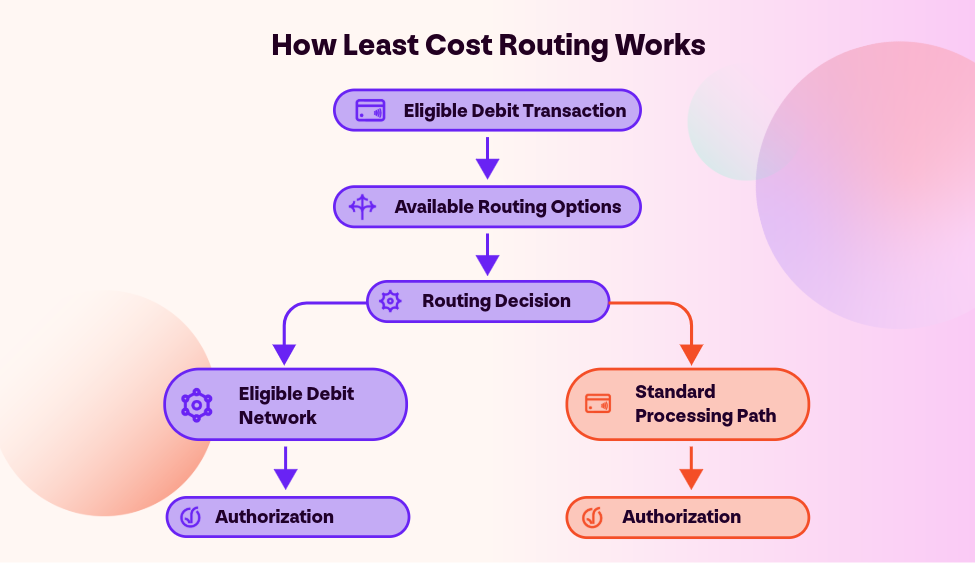
The routing decision happens behind the scenes. Merchants nor cardholders need to select a network or take additional action, so the checkout experience doesn’t change. For the cardholder, the payment looks and feels the same; the difference is in how the transaction moves through the payments ecosystem and the resulting cost of processing the transaction.
Why Debit Routing Affects Processing Costs
A cardholder making a $50 debit purchase sees the same $50 transaction regardless of which eligible network processes it. Behind that transaction, however, the economics can differ based on factors such as the network, card type, entry method, merchant category or industry, ticket size, pricing plan or model, and other transaction characteristics of the processing environment.
When multiple eligible routing paths are available, the cost of processing the transaction can vary depending on the route and factors mentioned earlier. That’s why the “least cost” in Least Cost Routing doesn’t mean identifying one debit network that’s universally the cheapest but rather is generally less expensive than standard routing. The economics can vary from transaction to transaction and LCR provides greater flexibility to account for those differences.
For a SaaS platform processing payments at scale, small differences at the transaction level can become more meaningful across a larger volume of eligible transactions. This is where debit routing moves from a behind-the-scenes processing detail to a potential payments optimization lever.
Least Cost Routing Eligibility
Not every debit transaction is eligible for Least Cost Routing. Eligibility can depend on factors such as card type, available debit networks, transaction characteristics, gateway and processor capabilities, and other possible requirements. Credit card transactions aren’t eligible for LCR.
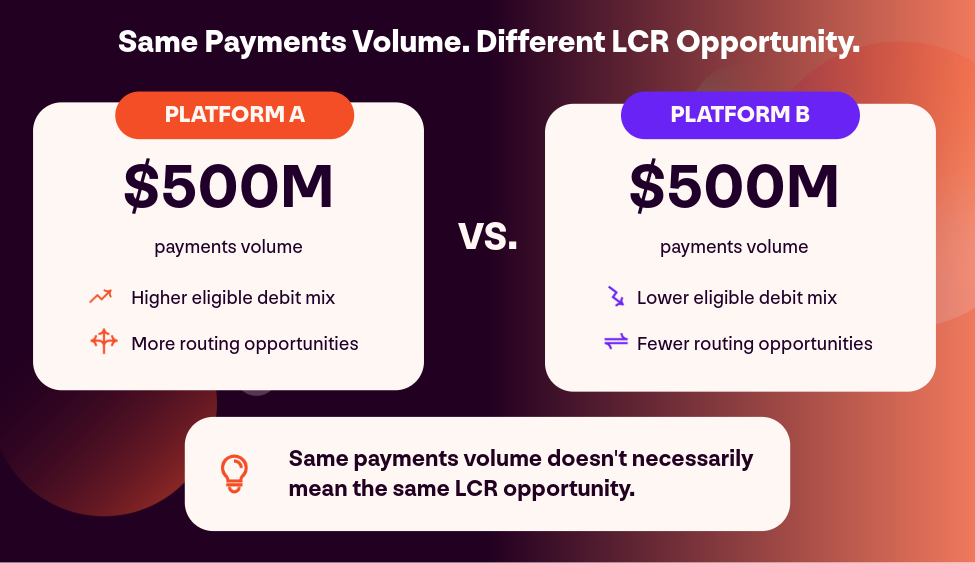
This matters because a software platform may process significant total payments volume while only a portion of those transactions are eligible for alternative debit routing. Two platforms with the same overall volume could therefore have very different amounts of eligible debit volume and different opportunities to optimize routing.
Eligible debit volume, not total payments volume alone, is the more meaningful starting point for evaluating LCR.
What Determines the Value of Least Cost Routing
The potential value of Least Cost Routing depends less on a software platform’s top-line processing volume than on the transactions within it.
Consider two software platforms that each process $500 million annually. One may have a higher concentration of eligible debit transactions and more available routing options, while the other may have a lower eligible debit mix or different transaction characteristics. Their total payments volume is identical, but their potential LCR opportunities could look very different.
Several factors can influence that opportunity:
- Eligible debit volume: How much of the platform’s payments volume may qualify for alternative debit routing?
- Transaction mix: What types of transactions make up that volume?
- Average ticket size: How might transaction characteristics, including ticket size, affect the economics of available routes?
- Card-on-file and recurring payments activity: What portion of the platform’s payments volume comes from recurring or card-on-file transactions that may be eligible for alternative debit routing?
- Available debit networks: Which eligible routing options are actually available?
- Current payments economics: How are transactions being routed and priced today?
These variables are also why LCR shouldn’t be approached with a universal savings assumption. Potential savings can vary based on transaction mix, pricing model, card types, and other characteristics of the portfolio. Specific savings can’t be guaranteed.
The value of Least Cost Routing isn’t simply having another way to route a transaction. It’s having more flexibility to optimize how eligible transactions move through the payments ecosystem with the result of reduced processing expenses.
LCR as Part of a Broader Payments Optimization Strategy
For a newer embedded payments program, many of the biggest priorities center on adoption: getting merchants activated, increasing payments penetration, and growing the volume processed through the platform. Those priorities don’t disappear as the program matures, but they aren’t the only ways to improve its performance.
As more volume moves through the platform, software companies can begin looking more closely at how efficiently those transactions are being processed and where there may be opportunities to improve the underlying economics. LCR can be one lever within that broader optimization strategy, alongside areas such as pricing, interchange, transaction mix, authorization performance, and other factors that influence payments economics.
This progression is part of moving beyond simply launching embedded payments. As we discuss in Why Most Embedded Payments Programs Plateau After Launch, continued growth requires SaaS platforms to keep evaluating the performance of their payments program and portfolio rather than treating implementation as the finish line.
A mature payments strategy isn’t only about finding more volume. It’s also about understanding the volume already flowing through the platform and identifying opportunities to make that payments program perform more effectively and reduce costs.
What SaaS Platforms Should Evaluate
Evaluating LCR doesn’t require software executives to become debit-routing experts. It does require understanding the characteristics of the payments portfolio and how routing optimization would fit into the broader payments strategy.
Start with eligible volume. What portion of the payments portfolio may qualify for alternative debit routing, and how are those transactions being routed today? From there, understand how routing decisions are made when multiple eligible options are available and how the economic impact of any changes would be measured.
It’s also important to understand how any economic benefit is reflected within the payments program. That can depend on the structure of the program, pricing model, and provider relationship. Looking at LCR within that broader context can help determine how routing optimization fits into the platform’s larger payments strategy.
Ultimately, the most useful question isn’t, “How much will LCR save us?” It’s “Where does routing optimization fit within the economics of our payments program?”
Conclusion: Optimizing the Volume You Already Have
Growing payments volume is an important milestone for any software platform. But as that volume increases, how transactions are processed becomes more relevant alongside how many transactions are processed.
Least Cost Routing provides another potential optimization lever by creating greater flexibility in how eligible debit transactions move through the payments ecosystem. The opportunity won’t be identical for every software platform because eligible debit volume, transaction mix, network availability, pricing, and existing routing economics all matter.
That’s why LCR is best evaluated as one component of a broader payments optimization strategy, not as a standalone promise to lower processing costs. As your payments program matures, the next opportunity may not only be finding more volume. It may also be getting more value from the volume you’re already processing!
Frequently Asked Questions About Least Cost Routing
Q. What is Least Cost Routing?
A. Least Cost Routing (LCR) is a payments optimization approach that routes eligible debit transactions across available debit networks based on a configured routing strategy. It provides additional routing flexibility that can help improve processing economics while maintaining transaction performance and compliance.
Q. How does Least Cost Routing work?
A. When an eligible debit transaction has multiple routing options available, LCR applies a configured routing strategy to determine which eligible debit network should process the transaction. If alternative debit routing isn’t available, the transaction can continue through its standard processing path.
Q. Does Least Cost Routing reduce payment processing costs?
A. LCR can create opportunities to reduce processing costs for eligible debit transactions, but savings aren’t guaranteed. The potential economic impact depends on many factors, including but not limited to, eligible debit volume, transaction mix, card types, pricing, available networks, and current routing.
Q. Does Least Cost Routing apply to every debit transaction?
A. No. Eligibility can depend on factors including program enrollment, card type, available debit networks, transaction characteristics, gateway and processor capabilities, and other possible requirements. Credit card transactions aren’t eligible for LCR.
Q. Does Least Cost Routing change the cardholder checkout experience?
A. No. LCR operates behind the scenes, so cardholders nor merchants need to choose a network or take additional action during checkout. The routing decision doesn’t change the cardholder’s payment experience.
Q. Does Least Cost Routing require changes to a payments integration?
A. In many cases, additional development isn’t required because LCR can be managed within the payment processing infrastructure and routing configuration established by the processor. Specific requirements can depend on the payments program and implementation.

by Xplor Pay
-
First published: October 23 2026
Written by: Xplor Pay