

TL;DR
- Agentic AI moves software beyond answering questions and assisting with tasks toward taking actions and working toward defined outcomes.
- Vertical SaaS platforms may have an advantage because they already understand specialized workflows, business rules, customer behavior, and industry context.
- The opportunity isn’t to add AI everywhere. It’s to identify where AI can remove work, make decisions, and improve important customer outcomes.
- Becoming more agentic starts with mapping the workflows a platform already owns and identifying where users still have to intervene.
- As AI agents move from recommending actions to executing them, capabilities such as payments, data, integrations, permissions, and governance become increasingly important.
What Does “Agentic” Actually Mean for Vertical SaaS?
Interest in agentic AI is growing quickly, but adoption is still relatively early. McKinsey found that 62% of organizations are at least experimenting with AI agents, while 23% have begun scaling an agentic AI system somewhere in the enterprise.
For vertical SaaS leaders, the bigger question isn’t whether AI agents are coming. It’s what becoming more agentic could actually mean for their platforms.
Most software today still depends on the user to drive the process. A user logs in, enters information, reviews data, makes decisions, and tells the software what to do next. Even many generative AI features operate within this model. They summarize information, generate content, answer questions, or make recommendations, while the user remains responsible for moving the workflow forward.
Agentic AI begins to change that relationship. Instead of waiting for a user to initiate every step, an AI agent can work toward a defined goal, determine which actions are needed, and execute some of those actions using the tools and information available to it.
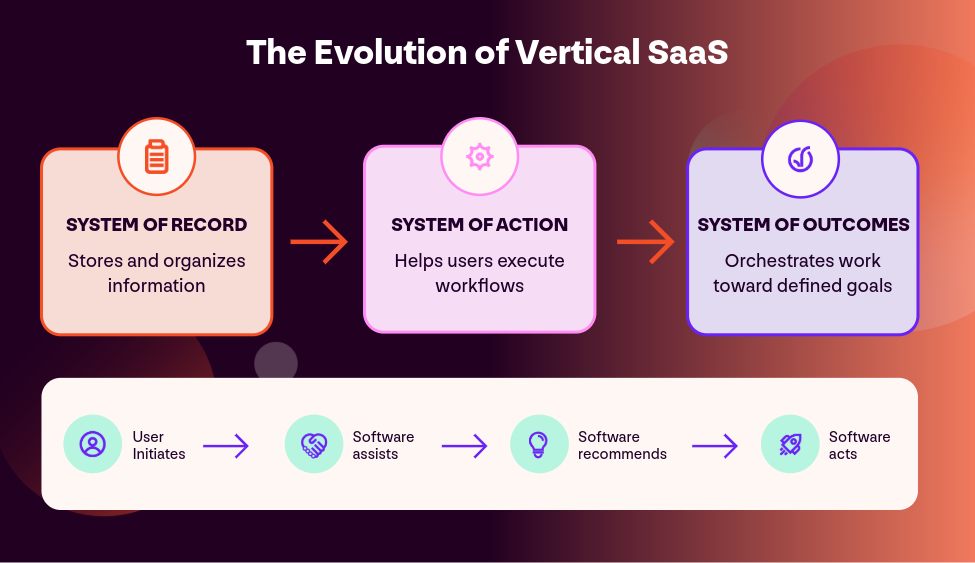
For vertical SaaS, this shift can be thought of as an evolution from systems that primarily store information, to systems that help users execute workflows, to systems that can increasingly orchestrate work toward defined goals.
A system of record stores and organizes the information needed to run the business. A system of action helps users execute workflows using that information. A system of outcomes goes a step further by helping determine what needs to happen next and taking approved actions toward a defined goal.
That’s a much bigger shift than adding an AI assistant to an existing product.
How Is Agentic Vertical SaaS Different From Agentic Commerce?
The terms are related, but they describe different things.
Agentic commerce focuses specifically on AI agents participating in commerce, including evaluating options, initiating purchases, and potentially completing transactions on behalf of users.
Agentic vertical SaaS is broader. It’s about how software platforms can increasingly participate in and orchestrate the workflows required to produce an outcome.
A home services platform, for example, might help manage customer records, estimates, schedules, technicians, invoices, and payments today. An increasingly agentic platform could eventually recognize that a recurring service is due, identify an appropriate appointment window, coordinate scheduling, assign a technician based on availability and location, communicate with the customer, and initiate the appropriate follow-up once the work is complete.
The transaction may be one part of that journey, but it can also be a critical point connecting what happened before the transaction with what needs to happen next.
Why Could Vertical SaaS Be Well Positioned for Agentic AI?
The power of agentic AI doesn’t come from AI alone. It comes from the context surrounding it. To take meaningful action, software needs to understand the environment in which it’s operating, including the customer, workflow, business rules, available resources, permissions, and desired outcome. Vertical SaaS platforms already sit inside many of those environments giving them the upper hand for Agentic AI.
A restaurant platform may understand reservations, tables, menus, orders, staff, payments, and customer behavior. A fitness platform may understand memberships, schedules, attendance, instructors, payments, and engagement. A trade school platform may understand enrollment, tuition, course schedules, attendance, completion, and student outcomes.
That vertical context could become increasingly important as access to AI models becomes more widespread. The AI model itself may not be the differentiator. The real advantage may come from the workflows, proprietary data, transaction data, integrations, permissions, and industry-specific context surrounding it.
Payments can add another layer of context by signaling when meaningful events, such as a purchase, renewal, upgrade, or completed service, have occurred.
Bessemer Venture Partners believes the opportunity could be significant. The firm predicts that Vertical AI’s market capitalization could eventually reach at least 10 times that of legacy vertical SaaS as AI allows platforms to address work that historically sat within the services economy.
That doesn’t mean adding AI automatically creates enterprise value. It suggests something more important: SaaS platforms may have an opportunity to expand the amount of work they can help their customers accomplish.
Why Should You Start With the Workflow, Not the AI?
One of the easiest mistakes SaaS leaders can make is starting with the question, “Where can we add AI?” A better question is: “What outcome is our customer trying to achieve, and what work stands between them and that outcome?”
This distinction matters because agentic AI may require more than automating today’s processes. Deloitte found that 74% of leaders expect nearly half of their business processes to be redesigned or rebuilt around AI agents within four years. Yet only 5% say their business processes are highly prepared for AI agents today.
Instead of layering AI onto every existing process, start by mapping the workflow from beginning to end. Look at the decisions users make, where they move between systems, where information is entered manually, where they wait for another person, and where predictable actions still require human intervention.
Consider a home services workflow:
Lead → Estimate → Scheduling → Service → Payment → Follow-up
An agent might eventually help qualify an incoming lead, prepare an estimate based on previous jobs, identify available technicians, suggest an appointment, trigger customer communications, initiate the appropriate payment workflow once service is complete, and use the transaction outcome to determine what should happen next.
The important point isn’t that AI should perform every step. It’s that the platform begins evaluating the entire outcome rather than looking for isolated places to add an AI feature.
What Happens When Software Starts Owning Outcomes?
The evolution toward agentic software is likely to happen gradually. A platform may begin by using AI to assist users, then progress toward recommending next steps and eventually taking approved actions on their behalf.
As platforms move further along that spectrum, the product strategy question begins to change from “What functionality does the customer need?” to “What work does the customer no longer need to do?”
That shift can have implications beyond product functionality. Removing work can improve the customer experience and create operational leverage. Owning more of an important workflow can deepen the platform’s relationship with the customer, create new data, open additional monetization opportunities, and make the platform more difficult to replace.
The next generation of vertical SaaS won’t just help users manage work. It will increasingly help get the work done.
This doesn’t mean removing people from every decision. The opportunity is to determine where human involvement adds value and where it simply adds work.
Why Do Guardrails Matter in an Agentic Platform?
As software moves from recommending actions to taking them, trust becomes increasingly important. Platforms need to determine what an agent is allowed to do, what data it can access, what limits apply, and which decisions require human approval. Monitoring and maintaining a clear record of an agent’s actions also become more important when software can execute actions across a workflow.
Many organizations are still developing these capabilities. Deloitte found that only 21% of enterprises surveyed have a mature governance model in place for agentic AI.
For vertical SaaS platforms, the right level of autonomy may also vary by action. Scheduling an appointment, sending a reminder, issuing a refund, and initiating a financial transaction don’t all necessarily require the same level of oversight.
The goal shouldn’t be maximum autonomy. It should be the right level of autonomy for the outcome, risk, and customer.
Where Do Payments Fit into an Agentic Platform?
As agents become capable of taking action, another question emerges: What happens when completing the workflow requires a financial transaction?
An agent that can schedule a service but can’t handle what happens when payment is due may only be able to complete part of the workflow. Over time, agents may need to operate within established permissions to perform actions such as triggering billing, initiating approved transactions, issuing refunds, or reconciling payments with other activity inside the platform.
Payments can also provide valuable context. A transaction may signal that a customer purchased, renewed, upgraded, attended, or completed another meaningful step. Those signals can help determine what should happen next in the workflow.
This is where embedded payments are particularly important. When payments are native to the platform and connected to the surrounding workflow, the platform has greater visibility into both the transaction and the business activity around it. That seamless connection is critical to be able to connect an agent’s decisions and actions to the financial outcome of the workflow.
For SaaS platforms, that makes payments part of a broader question: Can the platform not only determine the next action, but also execute the actions required to complete the outcome?
How Should Vertical SaaS Leaders Prepare for Agentic AI?
Becoming more agentic doesn’t require rebuilding an entire platform around AI. It requires being intentional about where greater autonomy could create meaningful customer and business value.
Start by asking five questions:
- What are our customers’ most important workflows? Focus on the outcomes customers rely on the platform to help deliver.
- Where does unnecessary work still exist? Look for repetitive actions, predictable decisions, manual handoffs, and work that happens outside the platform.
- Where do we have enough context to act? Consider the data, integrations, business rules, permissions, and industry knowledge required to make a reliable decision.
- Where should humans remain involved? Define where approval, oversight, or judgment remains important.
- What capabilities would allow us to own more of the outcome? AI may be only one part. Data, integrations, workflow orchestration, identity, permissions, communications, and payments can all play a role.
These questions help shift AI planning away from feature development and toward customer value.
What Could Agentic AI Mean for the Future of Vertical SaaS?
As AI capabilities become more accessible, simply having AI features won’t create a durable advantage. The more important differentiator is how deeply a platform understands and participates in its customers’ businesses.
Vertical SaaS platforms already have an important starting advantage: specialized workflows, industry knowledge, customer relationships, data, and integrations. Agentic AI creates an opportunity to put more of that context to work.
The platforms that create the most value may not be the ones that add the most AI. They will be the ones that identify the right outcomes to own, understand the workflows behind them, and build the capabilities required to take meaningful action. For many vertical SaaS platforms, owning more of those outcomes will also mean connecting AI to the data, workflows, and financial actions already taking place inside the platform.
Becoming agentic isn’t about adding AI everywhere. It’s about identifying where your platform can take greater responsibility for the outcomes your customers rely on it to deliver.
→ Continue the Conversation: Join Luke Sophinos, Mark Passifione, and Daniel Burton for Building More Valuable Vertical SaaS Companies, a live discussion on how AI, workflow ownership, and platform strategy are changing the growth playbook. Register Now
Frequently Asked Questions
Q. What is agentic vertical SaaS?
A. Agentic vertical SaaS refers to industry-specific software that uses AI agents to move beyond assisting users with individual tasks and toward taking actions across workflows to help achieve defined outcomes.
Q. How is agentic AI different from generative AI?
A. Generative AI primarily creates or interprets content, such as text, images, summaries, or answers. Agentic AI can use information and tools to plan steps, make decisions within defined parameters, and take actions toward an objective.
Q. How is agentic vertical SaaS different from agentic commerce?
A. Agentic commerce focuses on AI agents participating in commercial transactions. Agentic vertical SaaS is broader and can include agents coordinating or executing activities across an entire industry-specific workflow, with commerce representing one possible part of that workflow.
Q. Why could vertical SaaS platforms have an advantage with agentic AI?
A. Vertical SaaS platforms often have access to specialized workflows, industry knowledge, customer data, integrations, business rules, and transaction information. That context can help AI agents understand what actions are appropriate within a particular industry or workflow.
Q. How can a vertical SaaS platform prepare for agentic AI?
A. Start with customer workflows rather than AI features. Identify important outcomes, map the work required to achieve them, determine where manual intervention creates friction, and assess whether the platform has the data, integrations, permissions, governance, and infrastructure required to take action reliably.

by Xplor Pay
-
First published: September 04 2026
Written by: Xplor Pay