

TL;DR
- The strongest embedded payments launches begin well before go-live.
- Technical readiness and organizational readiness are not the same thing.
- Successful launches align product, sales, marketing, support, and leadership around how payments will go to market.
- Launch day begins the adoption phase. It does not complete the payments strategy.
- Long-term performance depends on what the organization learns and improves after launch.
Great Launches Start Before Go-Live
A software company can complete a payments integration and still be unprepared to launch a payments business.
The technology may work. Transactions may process correctly. The product may have passed every internal requirement. But when the first merchants become eligible to use payments, a different set of questions begins to matter.
Does the sales team understand how to position the offering and explain why a merchant should change the way they accept payments? Does marketing know which customers to target first? Does the support team understand the new experience? Does leadership know which metrics will determine whether the launch is working?
Those questions have little to do with whether the integration functions and everything to do with whether merchants adopt it. Two software companies can build similarly capable payment experiences and see very different results because one treated launch as the final stage of implementation while the other treated it as an organizational initiative.
Consider a vertical SaaS company preparing to introduce embedded payments to an established customer base. Product and engineering have spent months building the experience. As launch approaches, marketing creates an announcement, sales receives a product overview, and customers are told that payments are now available.
Technically, the company has launched. Commercially, it has only made payments available.
A more deliberate organization starts asking adoption questions much earlier, identifying which merchant segments are most likely to benefit, developing the value proposition around their workflows, preparing sales teams for likely objections, establishing an onboarding motion, and defining how adoption will be measured after launch.
The integration may be identical, but the conditions surrounding it are not.
Successful launches don’t happen because implementation finished. They happen because the organization was ready.
That distinction matters because embedded payments touches more of the organization than most software features. Product owns the experience, sales influences adoption, marketing creates demand, and operations and support shape the merchant relationship. Leadership determines whether payments remains a feature or develops into a strategic business.
Payments also introduces a different commercial challenge than many product launches. In most cases, merchants already have a way to accept payments. The launch is not simply introducing a new capability; it is asking merchants to reconsider an existing financial relationship and move a critical part of their business into the software platform.
That raises the bar for organizational readiness. Making payments available is unlikely to be enough on its own. The organization has to give merchants a compelling reason to change, equip customer-facing teams to communicate that value, and make the transition feel worth the effort.
When those teams begin preparing only as development nears completion, launch becomes a handoff. When they align earlier, launch becomes the first coordinated step in a larger growth strategy.
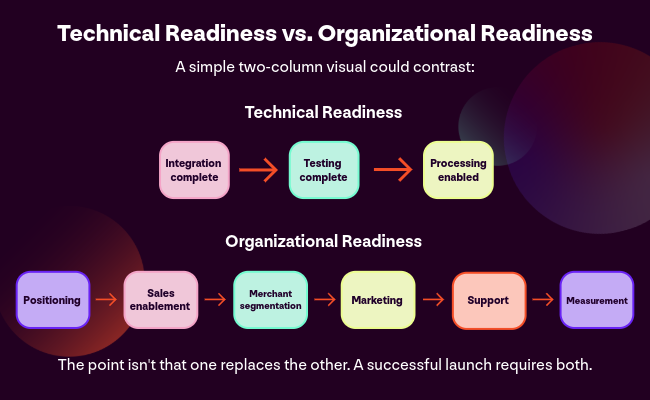
The point isn’t that one replaces the other. A successful launch requires both.
Launch Day Is Only the Beginning
Go-live creates availability, but it does not create adoption. That distinction is easy to overlook because so much organizational energy is concentrated on reaching launch. Development timelines, testing, certification, stakeholder meetings, and implementation milestones all point toward a single date, creating a natural sense that the hard work has been completed once that date arrives.
For the payments business, however, launch marks the beginning of a different kind of work: turning availability into adoption.
The first weeks and months reveal whether the assumptions made during planning hold up in the market. Which merchants adopt quickly? Where do prospects hesitate? Which parts of the value proposition resonate? Where does the sales conversation break down? What creates friction between interest and activation?
Consider a SaaS platform that launches embedded payments to 5,000 eligible customers. The company announces the new capability through email and asks its account team to mention payments during customer conversations. After three months, 400 merchants have enrolled.
The organization could interpret that as an 8% adoption rate and conclude that merchants simply aren’t interested. Or it could investigate the mechanics behind that number.
Perhaps newer customers adopt at significantly higher rates than the existing base. Perhaps multi-location merchants respond strongly while smaller businesses do not. Perhaps merchants who receive a live demonstration convert at twice the rate of those who receive email alone. Or perhaps customers begin enrollment but abandon the process at the same point.
Each finding suggests a different action, which is why moving beyond launch requires more than simply monitoring results. It requires an operating plan for adoption.
That means establishing clear ownership for payments performance, defining the metrics the organization will review, creating a regular cadence for evaluating merchant feedback and conversion data, and giving sales, marketing, product, and support teams a way to act on what they learn. The value comes from connecting what the organization is seeing to what it does next.
Turn Post-Launch Signals Into Action
| What You’re Seeing | What It Could Tell You | What to Do Next |
| One merchant segment converts at a higher rate | Your value proposition may resonate more strongly with that audience | Prioritize that segment in marketing and sales outreach |
| Prospects repeatedly raise the same objection | Your positioning or enablement may have a gap | Refine messaging and equip sales to address it |
| Merchants enroll but don’t activate | Friction may exist in the activation experience | Identify drop-off points and improve the experience |
| Adoption remains flat despite customer growth | Payments growth may be coming from SaaS growth, not stronger adoption | Revisit segmentation, positioning, and the GTM motion |
Turning those signals into action requires looking beyond processing volume. Transaction volume tells an organization what merchants are processing, while adoption, conversion, activation, and engagement data help explain how the payments business itself is performing and where the next opportunity for improvement exists.
Launch is not a single event, but the beginning of a recurring operating cycle.
Sales enablement should evolve as part of that cycle. The objections a team anticipates before launch will not always be the objections merchants actually raise. Early conversations create information that can sharpen messaging, improve training, and help account teams identify the customers most likely to convert.
Marketing should evolve with it. An initial launch announcement can create awareness, but sustained adoption usually requires more than one communication. Different merchant segments may need different messages, proof points, education, or reasons to reconsider an existing payment relationship.
The strongest launch strategies make room for that learning rather than assuming the initial plan will remain unchanged.
Building Momentum After Launch
The real test of an embedded payments strategy comes in the months after go-live. Once the initial launch activity settles, the question becomes whether the organization can turn what it is learning into sustained improvement.
A successful payments strategy should eventually be able to answer more demanding questions.
- Are more eligible merchants choosing the embedded solution?
- Is activation becoming easier?
- Are sales teams converting more opportunities?
- Are existing customers reconsidering outside providers?
- Is the payments experience becoming more valuable to merchants?
Answering those questions consistently requires an ongoing operating model for payments. Merchant behavior, sales objections, adoption data, and support interactions should continually inform where the organization invests and what it improves next.
Over time, this creates a feedback loop that makes the payments business stronger. The organization is no longer simply reacting to what happened after launch. It is continually refining how payments are positioned, sold, adopted, and experienced.
That’s when launch becomes less of an event and more of an operating system for growth.
The Launch Is a Beginning, Not a Finish Line
Reaching production is an important milestone. Building an embedded payments experience requires significant technical and organizational effort, but the companies that build durable payments businesses don’t simply ask whether they are ready to process transactions. They ask whether the organization is ready to create adoption, learn from merchants, and keep improving the program once transactions begin.
That changes what “launch readiness” means. It is no longer a question reserved for product and engineering. Sales, marketing, operations, support, and leadership all have a role in determining what happens after the switch is turned on.
The strongest organizations prepare for that work before launch, establish a rhythm for learning and optimization immediately afterward. Go-live isn’t the culmination of the payments strategy. It’s the point when the strategy begins to prove itself.
And that may be the more useful question for any software platform approaching an embedded payments launch:
Not “Are we ready to go live?” but “Are we ready for what happens after we do?”
Continue the Conversation
The operational work behind a successful payments launch is one of the topics Hannah Cummings explores on Payment Pulse, including what software companies should be thinking about before, during, and after bringing embedded payments to market.
Hear what successful embedded payments launches require before, during, and after go-live.
Frequently Asked Questions
Q: What makes an embedded payments launch successful?
A: A successful embedded payments launch requires more than a completed integration. It depends on organizational readiness across product, sales, marketing, operations, and support, with clear positioning, merchant onboarding, enablement, and measurement in place before go-live.
Q: When should a SaaS platform start planning for an embedded payments launch?
A: Launch planning should begin well before technical implementation is complete. Early alignment gives teams time to define target merchant segments, develop positioning, prepare customer-facing teams, establish an onboarding motion, and determine how adoption and performance will be measured after launch.
Q: What should SaaS platforms measure after launching embedded payments?
A: Processing volume is important, but it does not tell the whole story. Merchant adoption, enrollment and activation, conversion, engagement, and points of friction can provide a clearer picture of how the payments program is performing and where opportunities exist to improve.
Q: How can SaaS platforms increase payments adoption after launch?
A: Use early merchant behavior and feedback to continuously refine the go-to-market motion. That may mean prioritizing high-converting customer segments, addressing recurring sales objections, improving enrollment or activation, evolving merchant communications, and giving sales and support teams better tools based on what they are learning.
Q: What happens after an embedded payments program goes live?
A: Go-live begins the adoption phase. The strongest payments programs establish an ongoing rhythm for measuring performance, gathering merchant feedback, identifying friction, and applying those insights across product, sales, marketing, and support. Over time, that cycle can turn a payments capability into a more strategic part of the business.

by Xplor Pay
-
First published: August 25 2026
Written by: Xplor Pay