

TL;DR
- Processing volume measures activity. It says almost nothing about whether a payments program is being run with intention.
- Maturity depends on how deliberately a company keeps investing in payments, not on how many years the program has been live.
- Embedded payments move through five distinct stages, and the priorities, obstacles, and success metrics look different at each one.
- Executives get a clearer read on their program by asking a handful of pointed questions rather than defaulting to tenure or transaction count.
What Payments Maturity Actually Measures
Ask a SaaS executive how their payments program is doing, and the answer usually opens with a number: total volume processed, the share of revenue now tied to payments, or how many years the integration has been live.
These figures are easy to report and easy to compare quarter over quarter. But they’re also incomplete.
Volume tells you how much money moved through a platform. It doesn’t tell you whether that activity reflects a program built with intention or one that launched a few years ago and hasn’t been touched since.
A platform processing hundreds of millions of dollars annually can still be running the same onboarding flow, the same support model, and the same pricing logic it had on day one.
A platform with a fraction of that volume might be actively improving attach rates, expanding merchant participation, and treating payments as a real lever in its go-to-market strategy. Tenure and revenue alone can’t tell you which program is actually further along.
We looked at this gap from an investor’s vantage point in Embedded Payments Is Becoming a Diligence Topic in Vertical SaaS, which explores how sophisticated buyers assess payments programs during diligence. This piece takes the same underlying idea and points it inward: not how outsiders judge your program, but how you should judge it yourself.
Maturity has less to do with when payments launched and everything to do with whether the organization keeps investing in it afterward.
A two year old program with a dedicated owner, a regularly visited onboarding flow, and a clear monetization roadmap has the potential to be more mature than a five year old integration nobody has touched since it launched.
The patterns we share below come from our experience working with vertical SaaS platforms at every stage of this journey.
Five Stages, Five Different Jobs
Embedded payments programs tend to move through five stages, and the priorities at each one look nothing alike.
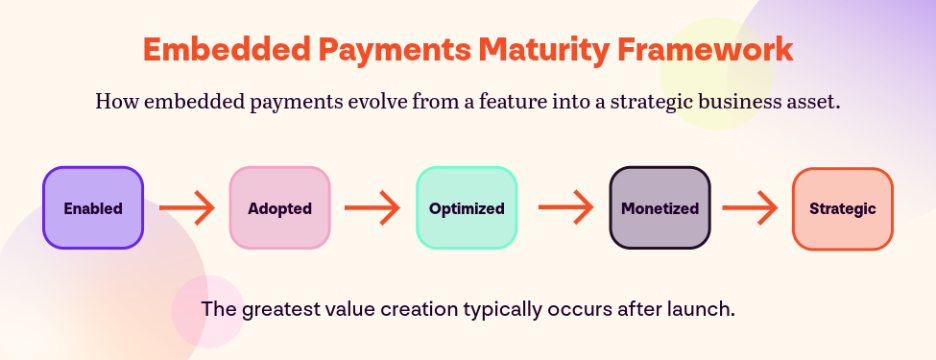
Enabled. The integration goes live, merchants can be boarded, and transactions can process. It’s a real milestone and worth treating as one, but success at this stage is largely defined by launch readiness: does the technology work, can merchants get boarded, and is the organization ready to support them?
Adopted. Once payments are live, the job becomes getting customers to actually use the integration instead of processing elsewhere. This is where payments transition from being a product initiative to a commercial one, pulling in sales, customer success, and marketing along the way. Adoption often stalls when no team clearly owns it, merchants don’t understand the value of switching, or friction in the sales and onboarding process gets in the way.
Optimized. As adoption builds, the spotlight moves toward how the program runs day to day: where onboarding creates friction, how efficiently support handles issues, and whether reporting gives merchants and internal teams what they need. Programs that skip this stage tend to plateau, still measuring success by launch-era standards long after the business around them has moved on.
Monetized. This stage gets misread as simply “making more money,” but it’s really about understanding the economics already in play: which customer segments generate the most value, how pricing should reflect that, and what margin the current model actually supports. A monetized program is being actively managed rather than left to run on whatever terms it launched with.
Strategic. At the final stage, payments start shaping the core product. Leadership asks how payments affects retention, where it belongs on the product roadmap, and what new opportunities it opens up. It’s now a capability the business builds around.
Note that none of these stages are a finish line.
Businesses launch new products, enter new markets, and acquire companies, and each of those milestones can send a program back into an earlier stage’s problems even after it reached a later one.
A team still solving Enabled-stage problems (like getting merchants boarded) while chasing Monetized-stage goals (like margin) tends to stall, because the groundwork underneath hasn’t caught up with the ambition.
Knowing which stage a program is genuinely in, rather than which stage leadership assumes it’s reached, is often the key consideration.
→ Related: Listen to our Payment Pulse podcast episode for a break down of the five stages of payment maturity.
The Questions That Reveal Where You Really Stand
Instead of starting with volume, executives get a better read on the health of their program by asking a few pointed questions.
- How has merchant adoption changed over the last twelve months, and is that shift the result of a deliberate initiative or just momentum?
- Who inside the organization owns payments day-to-day, and does that person have the authority to change onboarding, pricing, or product integration?
- When was the onboarding flow last revisited, and what prompted the change?
- If payments disappeared from the platform tomorrow, how much of the customer relationship would disappear with it?
None of these questions require a finance background to answer, but they do require being objective and honest. A leadership team that can’t answer them quickly is often looking at a program stuck at whatever stage it happened to reach at launch, coasting rather than advancing.
Embedded payments don’t mature simply because time passes. They mature because organizations continue investing in them.
Built to Keep Advancing
The organizations getting the most out of embedded payments aren’t the ones with the longest track record. They’re the ones that treat payments maturity as an ongoing discipline rather than a box checked at launch.
Xplor Pay’s Flex Framework was built around that same idea: a payments strategy should be able to move with a platform as its priorities shift, rather than locking a company into decisions made on day one.
Learn how the Flex Framework helps SaaS companies advance their payments strategy at every stage.
Frequently Asked Questions
Q. What does “payments maturity” mean for a SaaS platform?
A. It refers to how deliberately an organization manages and invests in its embedded payments program over time, not just how long the program has been live or how much volume it processes.
Q. Why doesn’t transaction volume indicate how mature a payments program is?
A. Volume reflects activity, not strategy. A platform can generate significant volume while running the same onboarding, support, and pricing model it launched with years ago, while a newer program under active refinement may be far more advanced.
Q. What are the five stages of the payments maturity model?
A. Programs move through five stages: Enabled, when the integration goes live and merchants can be boarded; Adopted, when the organization actively drives customers to use payments instead of processing elsewhere; Optimized, when the focus shifts to onboarding, support, and reporting; Monetized, when pricing and economics are actively managed rather than left as-is; and Strategic, when payments starts shaping retention, product decisions, and growth.
Q. How can executives tell which stage their program is actually in?
A. They should look past tenure and revenue and ask specific operational questions, like who owns payments internally, how adoption has trended over the past year, when onboarding was last updated, and how central payments has become to the customer relationship.
Q. Why do some payments programs stall despite being live for years?
A. Programs stall when investment stops after launch. Without a dedicated owner and ongoing attention to onboarding, adoption, and pricing, a program can remain at its launch-stage maturity indefinitely, regardless of how long it’s been running.

by Xplor Pay
-
First published: August 21 2026
Written by: michellem