

TL;DR
- Embedded payments programs rarely fail. They gradually stop evolving.
- Processing volume can create the illusion of success while adoption and operational efficiency remain stagnant.
- Organizations that treat payments as a feature eventually plateau.
- Organizations that treat payments as a business continue creating a competitive advantage.
- Payments maturity is not measured by longevity. It is measured by continuous improvement.
Most embedded payments programs do not fail overnight. They launch successfully, merchants begin processing payments, revenue grows, and internal teams move on to the next strategic priority. From the outside, the program appears to be working.
That apparent stability makes stalled maturity difficult to recognize. Unlike a product outage or a visible revenue decline, an embedded payments program rarely signals when it has stopped evolving. Processing volume can continue growing for years while merchant adoption slows, operational friction increases, and opportunities to strengthen the business go unrealized.
Payments maturity isn’t defined by how long a program has been in market. It’s defined by whether an organization continues improving adoption, operations, customer experience, and business outcomes after launch.
Growth Can Hide Stagnation
The most difficult embedded payments programs to improve are not the ones that are struggling. They are the ones that appear successful.
SaaS companies see processing volume continue to climb, merchants continue transacting, and revenue grows. Those indicators give leadership no obvious reason to revisit the payments strategy.
Yet growth can conceal a different problem entirely. As the business expands, merchant adoption levels off, operational friction becomes accepted as “the way things work,” and product innovation shifts to other priorities. The payments program continues generating revenue, but its strategic value begins to plateau.
Consider a vertical SaaS platform whose payment volume grows 20 percent because its overall customer base grew at the same rate. At first glance, payments appear healthy. But if the percentage of eligible merchants using the embedded solution has not changed, the program has grown without becoming more effective.
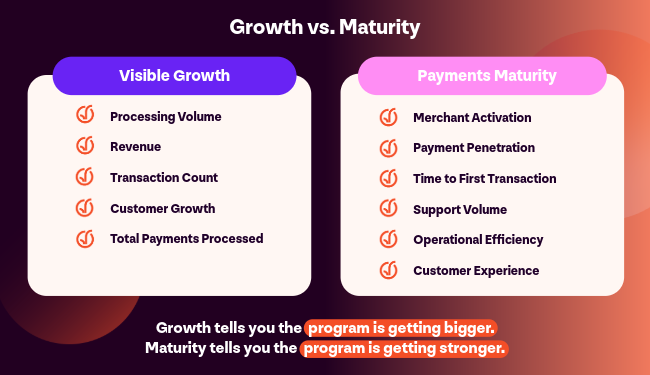
Many Many organizations continue measuring program health through transaction volume alone. While processing volume remains important, it says little about whether the payments business itself is becoming stronger. The organizations that outperform over time ask a broader set of questions:
- Is merchant adoption increasing?
- Are payment experiences becoming easier?
- Are operational costs decreasing?
- Are payments creating more value for customers and the business than they did a year ago?
Those questions reveal maturity in a way processing volume never can.
Four Signs Your Payments Program Has Stopped Maturing
Payments maturity rarely disappears overnight. More often, the problem appears through subtle patterns that organizations slowly begin accepting as normal.
1. Merchant adoption has plateaued
Launching embedded payments is only the first milestone. Sustained growth comes from increasing adoption across the platform, yet organizations often interpret a leveling activation rate as natural saturation. In many cases, the program has simply stopped receiving meaningful investment in onboarding, education, product improvements, or merchant engagement.
A merchant who never activates payments represents more than unrealized transaction revenue. The platform also loses an opportunity to increase product stickiness, improve the customer experience, and deepen the relationship through a workflow the merchant uses every day.
2. Payments is owned by one department
Payments may begin inside Product, Finance, or Partnerships, but long-term success depends on decisions made across Product, Customer Success, Sales, Marketing, Finance, and Operations. When ownership remainsisolated, each team can perform its individual role while no one remains accountable for improving the entire merchant journey.
A Product team may improve functionality while Sales continues positioning payments as an optional add-on. Customer Success may recognize onboarding friction without having the authority to change it. Mature payments organizations create shared accountability so that these decisions reinforce the same business objective.
3. Leadership measures transactions instead of business impact
Processing volume tells leadership how much money is moving, but it does not explain why. Organizations that continue maturing their payments business monitor merchant activation, payment penetration, onboarding completion, customer retention, support trends, and feature adoption alongside financial performance.
These measures distinguish growth created by a larger customer base from growth created by a stronger payments program. They also reveal where opportunities exist long before processing volume begins to slow.
4. Product innovation has moved elsewhere
Every SaaS company eventually shifts engineering resources toward new initiatives. The risk is not the change in priorities; it is the assumption that payments no longer require innovation. Customer expectations evolve, payment methods change, operational challenges emerge, and competitors improve their payment experience.
A payments program does not become mature because it has been in the market for years. It becomes mature because it continues evolving alongside the customers it serves. A flexible approach, such as the Xplor Pay Flex Framework, gives SaaS platforms room to adjust their payments strategy as their business, customers, and revenue needs change.
The greatest risk is not that your payments program fails. It is that it quietly stops improving.
The Hidden Costs
A payments program that stops maturing rarely creates a single point of failure. Instead, it introduces small inefficiencies throughout the business.
Customers encounter friction during onboarding, support teams answer preventable questions, and Operations builds manual processes to compensate for outdated workflows. Sales loses differentiation when competitors deliver a more seamless payment experience. Each issue may appear manageable on its own, but together they create meaningful drag on growth.
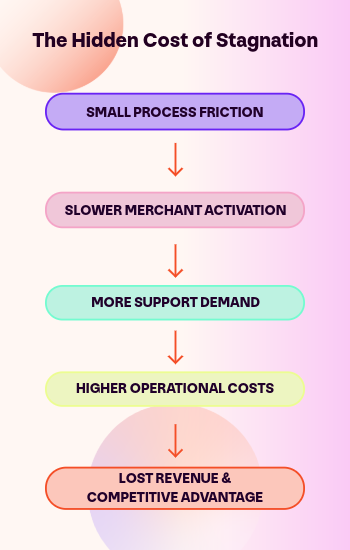
For example, a manual merchant review step may add only a few minutes to each application. As volume grows, that workaround increases time to activation, creates more status inquiries for support teams, and delays revenue. The cost is distributed across departments, which makes it easy to tolerate and difficult to measure.
Perhaps the greatest cost is the opportunity that is never measured. Organizations that stop improving payments often limit their value to transaction revenue alone, while competitors use payments to strengthen retention, improve operational efficiency, and increase enterprise value. As high-performing vertical SaaS platforms demonstrate, payments can become a core revenue engine when they are managed as a business rather than a feature.
Building the Business Behind Payments
The highest-performing payments organizations do not think of embedded payments as a product they have launched. They treat payments as a business they are continually improving, and that distinction changes where they invest their time.
They optimize adoption, not just availability
Offering embedded payments does not guarantee merchants will use them. Mature organizations continually evaluate onboarding, activation, education, and merchant engagement to increase adoption over time. Instead of asking, “Can customers enable payments?” they ask, “Why aren’t more customers choosing to?”
They remove operational friction
Every manual process is an opportunity for improvement. Rather than allowing workarounds to become permanent, mature organizations regularly evaluate where support teams, Operations, Finance, or merchants experience unnecessary complexity. Over time, incremental improvements compound into meaningful operating leverage.
They continuously improve the customer experience
Customer expectations do not stand still, and neither should payments. Whether the opportunity is simplifying onboarding, expanding payment options, improving reporting, or reducing payment friction, organizations that treat payments strategically improve the experience with each product cycle.
They measure the health of the business behind payments
Processing volume remains important, but it is not sufficient on its own. Leading organizations monitor the measures that predict long-term success:
- Merchant activation rate
- Payment penetration across the customer base
- Time to first transaction
- Customer retention among payment users
- Support volume related to payments
- Operational efficiency
- Feature adoption
Those measurements help leadership understand whether the payments business is becoming stronger, not simply larger.
Conclusion
A company that launched embedded payments five years ago is not necessarily more mature than one that launched six months ago. Time in market can build scale, but it does not automatically build organizational capability.
Payments maturity is defined by what the organization learns and improves after launch. The companies that create lasting competitive advantage continue examining adoption, ownership, customer experience, operating efficiency, and business impact even while the top-line numbers look healthy.
Embedded payments do not become strategic simply because they are embedded. They become strategic when the organization develops the discipline to keep building the business behind them.
Evaluate the Next Stage of Your Payments Program
If your payments program has reached a plateau, it may be time to evaluate what the next stage requires. Connect with Xplor Pay to discuss adoption, operations, and how to build a payments strategy that evolves with your platform.
Frequently Asked Questions
Q: What is payments maturity?
A: Payments maturity reflects how effectively an organization manages and improves its payments business over time, rather than simply how long the program has been in market. It includes adoption, customer experience, operational efficiency, cross-functional ownership, monetization, and the ability to evolve as business needs change.
Q: How can you tell if an embedded payments program has stopped maturing?
A: Common signs include plateauing merchant adoption, isolated departmental ownership, an overreliance on transaction volume as the primary success metric, and a lack of continued product or operational investment.
Q: Is processing volume enough to measure the health of a payments program?
A: No. Processing volume shows how much money is moving, but it does not show whether adoption is increasing, onboarding is improving, operational costs are decreasing, or customers are receiving more value from the payments experience.
Q: Which metrics should SaaS platforms track beyond payment volume?
A: Useful metrics include merchant activation rate, payment penetration, onboarding completion, time to first transaction, customer retention among payments users, payment-related support volume, operational efficiency, and feature adoption.
Q: How can a SaaS platform improve payments maturity?
A: Treat payments as a cross-functional business rather than a single product feature. Continually improve onboarding and adoption, remove manual processes, invest in the customer experience, measure business impact, and choose a payments strategy that can evolve as the platform grows.
Q: How does the Xplor Pay Flex Framework support payments maturity?
A: The Xplor Pay Flex Framework is designed to help SaaS platforms evolve their payments strategy as their business grows. Rather than locking organizations into a single operating model, the framework provides the flexibility to adapt as priorities shift from accelerating launch and increasing merchant adoption to gaining greater control, optimizing economics, and supporting long-term growth.

by Xplor Pay
-
First published: July 31 2026
Written by: Xplor Pay