

TL;DR
- Integrated and embedded payments both connect payments with software but differ in how deeply payments are built into the product experience and business model.
- Integrated payments connect payment processing to existing software workflows, helping platforms streamline operations and create a more convenient payment experience.
- Embedded payments create a more native payment experience within the platform, often giving software companies greater control over the merchant experience, branding, pricing and monetization.
- Software companies can choose from different payments partnership models based on how much control, responsibility and revenue opportunity they want.
- The right approach depends on your payments strategy, resources and long-term goals and can evolve as your business grows.
If you’re a software platform offering payments or considering adding them to your platform, you’ve likely encountered the terms “integrated payments” and “embedded payments”. While they’re sometimes used interchangeably, the differences can affect your product, customer experience, and payments strategy.
Understanding the differences can help you determine how payments should fit into your platform, how much control and responsibility you want to take on, and which approach best supports your business today and as it grows.
How Are Integrated and Embedded Payments Similar?
Integrated and embedded payments both connect payment capabilities with software to reduce manual processes, simplify payment acceptance, and create a more convenient customer experience. Both can also create new revenue opportunities for software companies.
What Is the Difference Between Integrated and Embedded Payments?
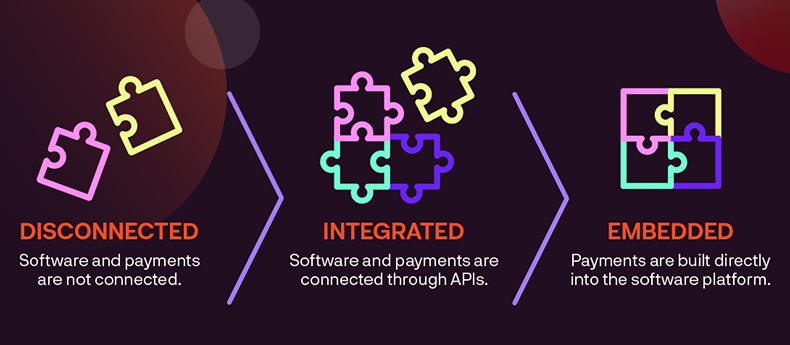
The biggest difference between integrated and embedded payments is how deeply payments are incorporated into the software platform and the role the software company plays in delivering the payments experience.
With integrated payments, payment processing is connected to the software so transactions and payment data can flow through existing workflows. The payments provider typically maintains a larger role in areas such as merchant onboarding, processing, and support.
With embedded payments, payments become a more native part of the platform and customer experience. Depending on the partnership model, the software company may have greater control over areas such as branding, merchant onboarding, pricing, support, and monetization.
| Area | Integrated Payments | Embedded Payments |
| Product Experience | Payments connect with existing software workflows | Payments are designed as a native part of the platform experience |
| Merchant Relationship | Payments provider typically plays a larger role | Software platform can take greater ownership |
| Branding | May include more provider visibility | Can offer greater control over the branded experience |
| Pricing | Typically less pricing control | Greater pricing flexibility |
| Revenue Opportunity | Can generate payments revenue | Greater revenue potential |
| Operational Responsibility | More responsibility remains with the payments provider | Can increase depending on the partnership model |
| Risk & Compliance | More responsibility typically remains with the provider | Responsibility varies based on the model |
| Speed to Market | Often faster and less resource-intensive | Varies based on the level of payments ownership |
→ Related: Listen to our Payment Pulse podcast episode to learn the key differences and benefits of integrated and embedded payments.
What are Integrated Payments?
Integrated payments connect payment processing directly with a software platform, allowing payments and payment data to flow through the workflows customers already use. Instead of managing payments through a separate system, users can accept payments and access related information within the software.
These connections are typically enabled through APIs (Application Programming Interfaces) and SDKs (Software Development Kits), which allow the software and payments systems to communicate.
For example, a field service platform might integrate payments so a contractor can create an invoice, accept a card payment and automatically update the customer’s account without entering the same information in multiple systems.
What Are the Advantages and Tradeoffs of Embedded Payments?
For many software companies, integrated payments offer a relatively straightforward way to add payment capabilities without taking on significant payments complexity.
Advantages of Integrated Payments
Simplified operations: Connecting payments with existing software workflows can reduce manual data entry, improve accuracy and make it easier for customers to manage payments alongside other business activities.
Faster path to market: Because the payments provider typically handles more of the payments infrastructure and operational responsibilities, software companies can often bring integrated payments to market with fewer internal resources.
Revenue opportunity: Integrated payments can create an additional revenue stream without requiring software companies to take on greater payments responsibility.
Tradeoffs of Integrated Payments
Less control: Software companies may have less control over areas such as merchant onboarding, pricing, branding and support, depending on the payments partnership.
Greater provider involvement: The payments provider typically maintains a larger role in the merchant relationship and overall payments experience.
What Are Embedded Payments?
Embedded payments make payment capabilities a native part of the software platform and customer experience. Rather than payments feeling like a separate service connected to the software, they become part of the workflows customers already use to run their businesses.
Depending on the payments model, software companies can gain greater control over merchant onboarding, branding, pricing, support, and the overall payment experience.
For example, a field service platform with embedded payments could provide a branded experience that allows contractors to sign up for payments, accept transactions, manage payment activity and access reporting without payments feeling like a separate third-party service.
What Are the Advantages and Tradeoffs of Embedded Payments?
Embedded payments can give software companies greater influence over how payments fit into their product, customer experience and business model. That additional control can create significant advantages, but it also requires companies to think carefully about how much payments responsibility they want to assume.
Advantages of Embedded Payments
More seamless customer experience: Payments can be designed around the platform’s existing workflows and brand, making the experience feel like a natural extension of the software.
Greater control: Software companies can have more influence over how payments are delivered, priced, and supported.
Increased revenue potential: Greater control over the payments program can create more opportunities to optimize pricing, increase payment adoption, and build payments into the platform’s broader revenue strategy.
Tradeoffs of Embedded Payments
Greater resource requirements: Creating and managing a more embedded payments experience may require additional product, development, and operational resources.
More operational responsibility: As software companies take greater ownership of payments, they may also take on more responsibility for areas such as merchant support, onboarding, and payment operations.
Additional risk and compliance considerations: Greater payments ownership can bring additional responsibilities, although how much the software company assumes depends on the partnership model.
Do You Have to Become a Payment Facilitator to Offer Embedded Payments?
No. Software companies don’t have to become full payment facilitators to offer an embedded payments experience.
Different partnership models allow software companies to choose how much of the payments experience they want to control and how much operational and compliance responsibility they want to assume. For example, a software company may want greater control over the merchant experience and payments monetization while relying on its payments provider for areas such as underwriting, risk and compliance.
How Do Payments Partnership Models Differ?
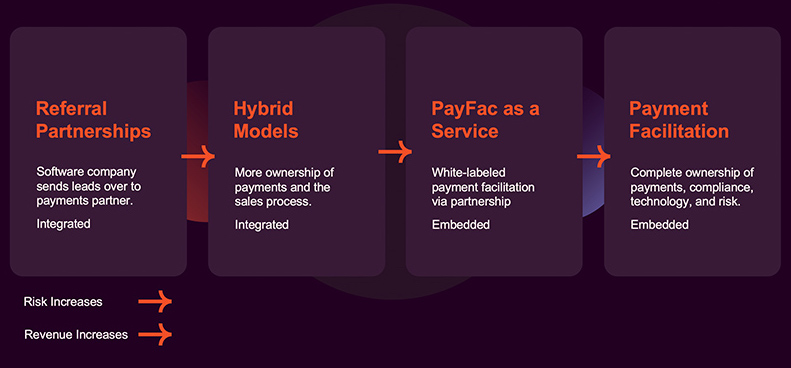
Software companies have several options for structuring their payments partnerships. These models vary in how much control the software company has, the responsibilities it assumes and the revenue opportunity it can capture.
Referral: The payments provider typically manages merchant sales, onboarding, activation, support and payment processing. The software company refers customers to the provider and may receive a share of payments revenue. This model offers a relatively simple way to provide integrated payments with limited operational responsibility.
Hybrid: The software company takes a more active role in the payments experience while continuing to rely on its payments provider for much of the operational infrastructure. This provides greater control over the merchant relationship without requiring the platform to manage the entire payments program.
PayFac as a Service (PFaaS): The software company can create a more embedded, branded payments experience while relying on its payments partner for much of the infrastructure, risk and compliance. This model can provide greater control and revenue potential without requiring the software company to become a full payment facilitator.
Payment Facilitator: The software company assumes the greatest level of payments ownership and responsibility. This can provide greater control over the merchant experience, pricing and economics, but also requires significantly more operational, risk and compliance resources.
Which Payments Model Is Right for Your SaaS Platform?
The right payments model depends on your business goals, resources and the role you want payments to play within your platform. For some software companies, an integrated approach provides the right balance of simplicity and revenue opportunity. For others, a more embedded approach can provide greater control over the customer experience, pricing, and revenue.
As you evaluate your options, consider questions such as:
- How important are payments to your overall product and growth strategy?
- How much control do you want over the merchant experience, pricing and branding?
- How much operational, risk and compliance responsibility are you prepared to take on?
- How quickly do you want to bring payments to market?
- How important is payments revenue to your long-term business model?
- Will your payments needs change as your platform and customer base grow?
Your payments needs may also change as your platform grows. The Xplor Pay Flex Framework is designed around that reality, giving software companies different paths for launching and growing payments based on the level of control, responsibility and revenue potential, and the ability to evolve as their needs change.
Wrapping Up
The right payments strategy depends on the role you want payments to play in your product and business. Integrated payments can provide simplicity and speed, while a more embedded approach can offer greater control over the merchant experience, pricing and monetization.
What matters is choosing a model and payments partner that support your needs today without limiting where you can go next.
Frequently Asked Questions
Q. What is the difference between integrated payments and embedded payments?
A. Integrated payments connect payment processing to a software platform so payments and payment data can flow through existing workflows. With embedded payments, the payment experience becomes a more native part of the platform, giving software companies greater control over areas such as branding, pricing and monetization.
Q. Which is better for software providers: integrated payments or embedded payments?
A. Neither approach is inherently better. The right choice depends on the role payments play in your business, how much control you want over the payments experience, your available resources and how much operational responsibility you want to assume. Integrated payments may be a good fit for platforms prioritizing simplicity and speed to market, while embedded payments may be better suited to platforms seeking greater control and revenue potential.
Q. Why can embedded payments offer more revenue potential?
A. Embedded payments can give software companies greater control over areas such as pricing, merchant adoption and the overall payments experience. That additional control can create more opportunities to optimize payments revenue as the program grows.
Q. Do you have to become a PayFac to offer embedded payments?
A. No. Software companies can offer embedded payments without becoming full payment facilitators. Models such as PayFac as a Service can provide greater control over the payments experience while allowing a payments provider to continue supporting areas such as infrastructure, risk and compliance.
Q. Can a software company make payments more embedded over time?
A. Yes. As payments become more important to a software company’s product and growth strategy, the company may choose to take greater control over areas such as the merchant experience, pricing, branding and monetization.
That evolution doesn’t necessarily require becoming a full payment facilitator or replacing the entire payments program. With the right partnership model, software companies can increase their level of payments ownership as their needs evolve.

by Xplor Pay
-
First published: May 14 2024
Written by: Xplor Pay