


Building a More Connected Payments Foundation Retail SaaS
How one retail SaaS provider moved beyond a fragmented payments model to build a more unified payments foundation with Xplor Pay.

Payments Were Integrated.
The Payments Model Wasn’t.
For this retail SaaS provider, creating a connected experience for merchants was already central to its software platform. Payments were part of that experience, integrated into the same software merchants used to manage their business.
Behind that connected experience, however, different vendors supported different pieces of the payments ecosystem.
While merchants saw one software platform, the SaaS provider managed multiple payments relationships behind it.
As payments became more important to both the platform and the merchant experience, that disconnect began to matter more.
This retail SaaS provider didn’t need to figure out how to add payments to its software. Payments were already there; what it needed was a payments model that better matched the connected experience it was building for merchants.
When Payments Become More Strategic, the Model Behind Them Matters
For many SaaS providers, payments begin as an integration: the software connects to payments, merchants can accept transactions, and another capability becomes part of the platform. But as payments take on a more meaningful role in the software business, expectations begin to change.
The conversation expands beyond simply enabling transactions to consider how payments fit into the merchant experience, align with the rest of the software, and evolve alongside the platform.
For this retail SaaS provider, the existing model had already solved for payment acceptance.
The next step was building the payments strategy behind it.
Rethinking the Role of Payments
The opportunity wasn’t simply to swap one processor for another. It was to rethink how the payments relationship itself could better support the business.
Working with Xplor Pay, this retail SaaS partner moved away from a model supported by different backend vendors and toward a more unified payments relationship. Rather than continuing to approach payments as separate pieces operating behind the software, the provider could take a more holistic view of payments, with both the merchant experience and direction of its platform in mind.

From Fragmented Infrastructure to a More Connected Foundation
Before
- Multiple payments relationships behind one software experience
- Fragmented structure behind a connected merchant experience
- Different pieces of the payments ecosystem approached separately
- Payments primarily viewed through acceptance and integration
- Infrastructure that had evolved in pieces
With Xplor Pay
- A more unified payments relationship behind the platform
- A payments foundation better aligned with the software
- More of the payments relationship brought together
- Payments considered within the broader platform strategy
- A foundation designed to evolve alongside the software business

What a More Unified Payments
Relationship Changed
Bringing More of the Payments Relationship Together
Previously, different providers supported different pieces of the payments ecosystem. Moving toward a more unified relationship with Xplor Pay brought more of the strategy behind payments together, creating greater alignment between what merchants experienced in the software and how the SaaS provider approached payments behind it.
Making Payments Part of the Platform Conversation
That shift also changed how the SaaS provider could think about payments. Rather than focusing primarily on whether payments could be accepted through the software, the provider could increasingly consider payments in the context of the broader platform:
- How should payments fit into the merchant experience?
- How should the payments relationship support the direction of the software?
- How should that foundation evolve as the platform evolves?
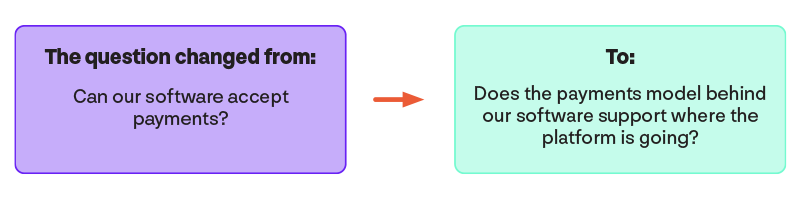
A payment integration answers, “How do we accept payments through our software?”
A payments strategy asks, “What role should payments play in our platform?”

Retail Was Already Connected. Payments Needed to Keep Up.
The need for a more connected payments model was particularly relevant in retail, where software increasingly sits at the center of the merchant’s business, bringing together point of sale, inventory, customer management, commerce, and other operational experiences. Payments naturally touch many of those same moments.
Today’s merchants may interact with customers at the counter, online, through mobile experiences, or across several channels at once. McKinsey found that omnichannel small businesses typically operate across three or four sales channels, reinforcing the need for the technology supporting those businesses to work across an increasingly connected retail experience.
As retail software becomes more connected, the payments model behind it needs to support that same experience.

Why This Shift Matters Now
This retail SaaS provider’s experience reflects a larger shift taking place across software and payments. More than 90% of U.S. small and medium-sized enterprises (SME) surveyed use a vertical software solution, according to McKinsey’s 2025 Merchant Acquiring Survey. At the same time, payment-processing revenue flowing through software providers continues to grow, reinforcing the expanding role payments play within the software experience.
U.S. payment-processing revenue through the ISV channel was projected to reach $16 billion in 2025, up from $6.5 billion in 2020. McKinsey also reported that the ISV payments channel was growing approximately three times as fast as traditional channels.
Industry Perspective
Building for What Comes Next
Retail SaaS providers have spent years making the merchant experience more connected, and payments shouldn’t be left behind as the fragmented part of the business.
For this retail SaaS provider, payments were already integrated into the software. The opportunity was behind that experience. By working with Xplor Pay, the provider moved away from a fragmented payments model and toward a more unified relationship, bringing the payments foundation closer to the connected software experience it had already built.
The transformation wasn’t about adding payments to the platform. It was about changing the role payments played within it. With a stronger foundation behind the experience, the SaaS provider is better positioned to continue evolving payments alongside its software and the merchants it serves.

Ready to Build a More Connected Payments Strategy?
A seamless payments experience requires more than technology. It requires a payments strategy built to support it.
Xplor Pay helps SaaS providers bring more of that relationship together, creating a stronger foundation for the merchant experience and the payments strategy behind it.
Article by Xplor Pay
First published: October 14 2026
Last updated: October 14 2026